Internship at
Stem Agency
Internship at
Stem Agency
Internship at
Stem Agency
Period: 5 weeks - 2025
Period: 5 weeks - 2025
Accessibility and usability
Accessibility and usability
During my internship at Stem Agency, I carried out web analyses focusing on accessibility and usability in websites developed by the agency for different clients.
During my internship at Stem Agency, I carried out web analyses focusing on accessibility and usability in websites developed by the agency for different clients.
The report outlines the strengths, weaknesses, and possible areas for improvement.
The report outlines the strengths, weaknesses, and possible areas for improvement.
During my internship at Stem Agency, I carried out web analyses focusing on accessibility and usability in websites developed by the agency for different clients.
The report outlines the strengths, weaknesses, and possible areas for improvement.

Purpose and Method
Purpose and Method
I based my work on the WCAG (Web Content Accessibility Guidelines) — an international framework for universal design in digital solutions.
With guidance from the Norwegian Digital Accessibility Authority, I evaluated elements such as navigation, structure, contrast, text alternatives, and keyboard navigation against the requirements.
In addition, I conducted a heuristic evaluation based on Jakob Nielsen’s ten usability principles.
These principles helped me assess how intuitive, consistent, and error-preventive the solution is, and how well it supports users’ needs in practice.
The goal of the analysis was to evaluate how well the websites meet accessibility and usability standards — identifying strengths, weaknesses, and opportunities for improvement to create a better user experience.
Manual Testing and Tools
Manual Testing and Tools
To ensure a comprehensive and well-founded evaluation, I combined international standards, national guidelines, and user-centered principles.
I applied both manual testing and the following tools:
WAVE – an accessibility tool that visualizes interface issues such as low contrast and missing alternative text.
Lighthouse – a Google Chrome tool that analyzes a website’s accessibility, performance, and SEO. It provides an overall score along with detailed suggestions for improvement.
The goal
The goal of the analysis was to evaluate how well the websites meet accessibility and usability standards — identifying strengths, weaknesses, and opportunities for improvement to create a better user experience. I applied both manual testing and the following tools:
These principles helped me assess how intuitive, consistent, and error-preventive the solution is, and how well it supports users’ needs in practice.
Purpose and Method
I based my work on the WCAG (Web Content Accessibility Guidelines) — an international framework for universal design in digital solutions.
With guidance from the Norwegian Digital Accessibility Authority, I evaluated elements such as navigation, structure, contrast, text alternatives, and keyboard navigation against the requirements.
In addition, I conducted a heuristic evaluation based on Jakob Nielsen’s ten usability principles.
Manual Testing and Tools
To ensure a comprehensive and well-founded evaluation, I combined international standards, national guidelines, and user-centered principles.
I applied both manual testing and the following tools:
WAVE – an accessibility tool that visualizes interface issues such as low contrast and missing alternative text.
Lighthouse – a Google Chrome tool that analyzes a website’s accessibility, performance, and SEO. It provides an overall score along with detailed suggestions for improvement.
Website Analysis Report
Website Analysis Report
Website Analysis Report
This analysis report evaluates accessibility and usability in websites designed by Stem Agency
The goal is to assess how well the websites meet current standards and to ensure an optimal user experience by identifying key strengths, weaknesses, and opportunities for improvement.
The project was completed in collaboration with a fellow student. We divided the responsibilities between us, and I was in charge of my part of the process — from selecting methods to conducting the evaluation and documenting the results.
During my internship, I analyzed websites from various companies. gave me experience in evaluating solutions across different industries and target audiences, as well as insight into how design choices influence accessibility and usability.
For confidentiality reasons, I have removed the logos and names of the websites involved.
For confidentiality reasons, I have removed the logos and names of the websites involved.
During my internship, I analyzed websites from various companies. gave me experience in evaluating solutions across different industries and target audiences, as well as insight into how design choices influence accessibility and usability.
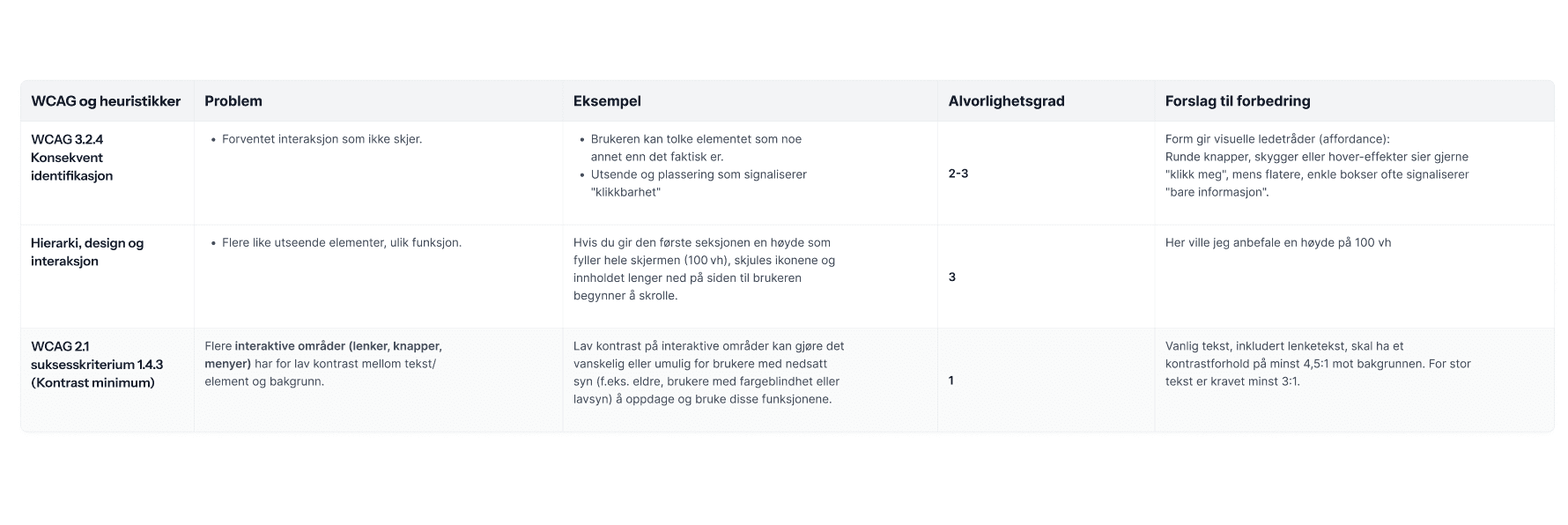
Example of Main Findings from the Analysis Report
Example of Main Findings from the Analysis Report
Arbeidet inkluderte idéutvikling, wireframing i Figma, prototyping, og iterativ brukertesting. Jeg la vekt på strukturert informasjonsarkitektur og tydelig hierarki for å sikre en sømløs kjøpsopplevelse.